SILICON MEETS CODE · HENRIK ANDERSEN

Electronic engineering consultant. Embedded hardware and firmware, from idea to production.

Illustration: a circuit board with a microcontroller at its centre, a charging battery and an antenna feeding a low-noise amplifier, linked to an in-circuit debugger stepping through its C code. Around it: an oscilloscope showing a 2.498767 MHz carrier amplitude-modulated by a 100 kHz tone, a 16-channel logic analyser, a dense PCB layout with two active nets, SPI_SCK and SPI_MOSI, highlighted, a spectrum analyser showing the same carrier with its two sidebands 100 kHz either side, an EMC pre-scan that passes and a unit test run in which 50 of 50 tests passed.BATC3C4J1U2R7R8ANTLNATP1TP2TP3TP4PWRTXRXU1ICE · DEBUG SESSION● RUN❚❚ HALT41void ble_task(void) {42  int v = adc_read();43  v = filter(v);44  ble_notify(v);45}WATCHv0x0A3F0x0A410x0A3CPC0x1A2C0x1A300x1A34SP0x7FE80x7FE80x7FE0irq334EMC pre-scanPASSUnit test50 / 50 tests passed10110101101OSCILLOSCOPE · CH1AM · m = 60 %fc 2.498767 MHzfm 100 kHz243 mVppLOGIC ANALYZER · 16 CH24 MS/sD0D1D2D3D4D5D6D7D8D9D10D11D12D13D14D150x3A7FPCB LAYOUT · 4 LAYERSDRC 0NET SPI_SCKNET SPI_MOSISPECTRUM ANALYZERspan 500 kHzM1center 2.498767 MHzM1 −12.4 dBm

Full R&D and project management for consumer and industrial electronic products: circuit and PCB design, embedded firmware, verification and validation, through to start of production. One experienced engineer for the complete development, or just the part you need.

  • 30 years of R&D in hardware and software
  • Production set up with EMS partners in Europe and China
  • No payment until you approve the delivery
04 Hardware

Hardware design

Circuit design, schematic, PCB layout and design reviews.

05 Firmware

Embedded firmware

Decades of know-how in C on Arm Cortex-M, RISC-V and MCS-51.

07 Test & certification

Verification & validation

Integration, verification, validation, EMC pre-compliance and acceptance tests.

08 Production ready

Production-ready

Ready for manufacturing in Europe and Asia, with full DFM reports.

ENGINEERING SERVICES

Full R&D, from idea to production.
Or just the part you need.

Hand over the complete development, with project management from start to finish, or one part your team needs. Each service links to its phase.

01–08 All phases

Complete product development

Full R&D and project management: requirements, circuit and PCB design, firmware, prototypes, verification and validation, and the set-up of production with an EMS partner in Europe or China. One engineer, one plan, a finished product.

See the eight phases
02 Documentation

Documentation package

Requirements, specification, architecture and test plans: written, reviewed and traceable.

Learn more about documentation package
04 Hardware

Independent hardware review

A second pair of eyes on your schematic and layout, with a written report.

Learn more about independent hardware review
05 Firmware

Firmware only

Your hardware, my code: drivers, RTOS, connectivity and secure updates.

Learn more about firmware only
06 Prototype

Prototype build

From design files to working, measured units on your desk.

Learn more about prototype build
07 Test & certification

EMC pre-compliance check

Find and fix EMC problems early, before formal compliance testing.

Learn more about emc pre-compliance check
08 Production ready

DFM and cost-down review

Make an existing product easier and cheaper to build.

Learn more about dfm and cost-down review
04 Hardware

Obsolescence redesign

Replace parts that are no longer available, without starting over.

Learn more about obsolescence redesign
04 Hardware

Redesign and reverse engineering

Lost the files for an old board? Schematic and BOM recovered from your PCBA, then redesigned for lower cost and current parts.

Learn more about redesign and reverse engineering

THE 8-PHASE LIFECYCLE

From idea to start of production.
Or just the part you need.

I take products through all eight phases, with project management from start to finish. Or join the loop with what you already have: an idea, a specification, a schematic or a prototype, and stay for as many phases as you need.

The development loop

Select a phase to see what it includes: point, tap, or use the Tab key.

All eight phases

Full R&D

From the first idea to start of production, with project management.

Several phases

Part of the development

For example from schematic to a working prototype.

One phase

One deliverable

A specification, a hardware review or the firmware for your design.

THE METHOD

The V-model behind the loop.
Every design step has its test.

OUR MISSION

Get your product right before it gets expensive.

Every requirement written down, every design step reviewed, every test agreed before it runs. That is how a product reaches production without late surprises.

Each level on the left is checked by its partner on the right: units against the detailed design, integration against the architecture, the system against its requirements, and the finished product against what the customer asked for. The numbers show where each step sits in the development loop.
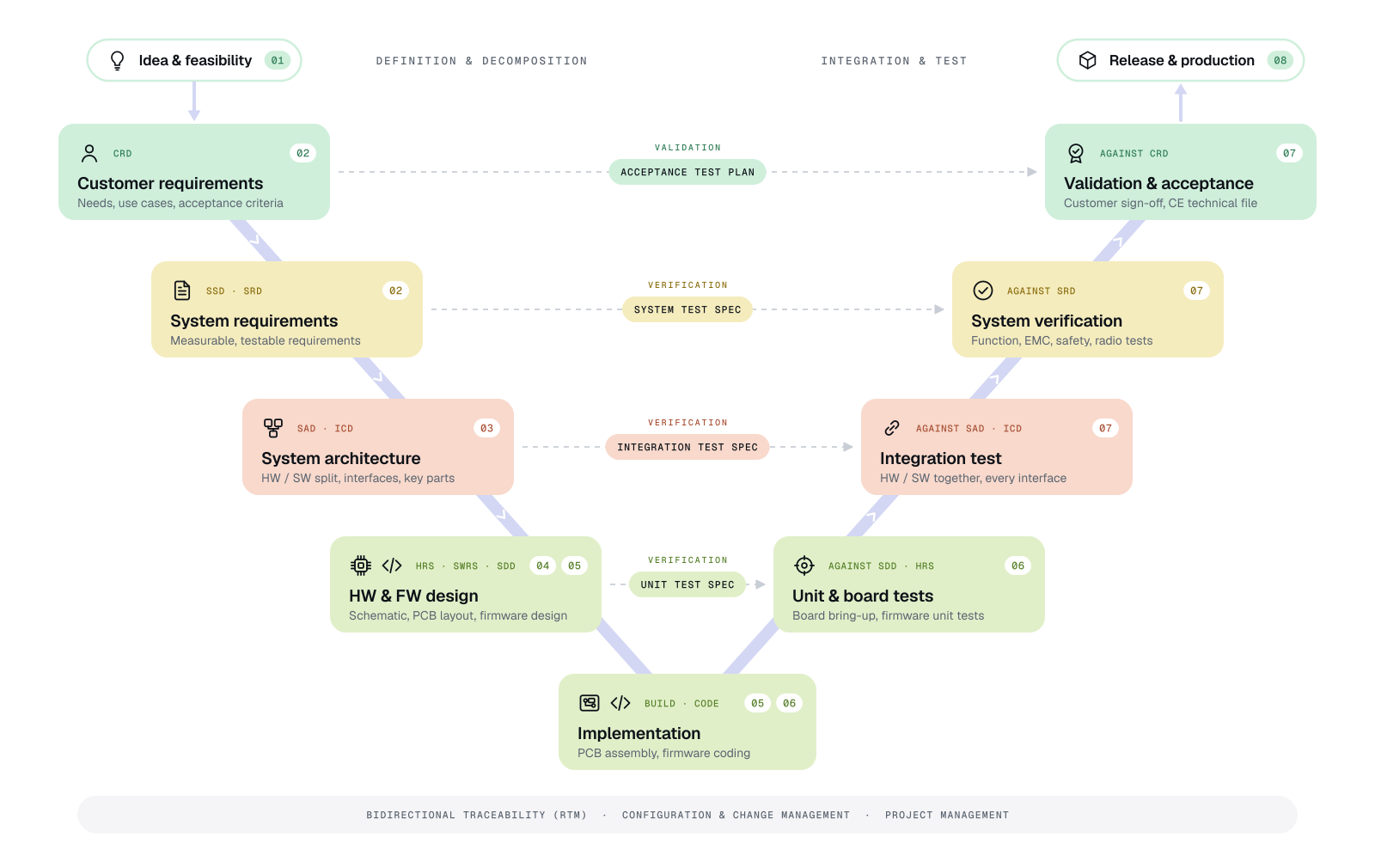
V-model for embedded products. Left, from top to bottom: customer requirements (CRD), system requirements (SSD, SRD), system architecture (SAD, ICD), hardware and firmware design (HRS, SWRS, SDD). Bottom: implementation, PCB assembly and firmware coding. Right, from bottom to top: unit and board tests, integration test, system verification, validation and acceptance. Each level has its test specification. It starts with idea and feasibility and ends with release and production.
Define

Left side of the V

What the product must do, written and agreed with you: from your needs down to the schematic and the firmware design.

Build

The bottom of the V

Hardware and firmware made exactly to that design: PCB assembly and firmware coding.

Prove

Right side of the V

Each level tested against its own document, from single boards up to your final acceptance.

Thirteen practices, phase by phase.

Each one is used where it belongs in the development loop. Open a practice to see how it works and what you receive.

01 Idea

Risk management and technical feasibility

Uncertainties are resolved early through analysis, experiments and prototypes, while changes are still cheap. Every risk is tracked from the moment it is found until its mitigation is done.
02 Documentation

Design reviews and decision gates

At the end of each stage, a review establishes whether the evidence supports moving on to the next one. You see the evidence, the findings and the decision, and the next stage starts only with your approval.
03 Architecture

Systems engineering and HW/SW partitioning

Each function from the requirements is allocated to hardware, firmware or software, balancing performance, cost, power and timing. Decided early, it keeps the design lean and the interfaces clear.
03 Architecture

Component and supplier management

Availability, approved alternatives, lifecycle, quality and supplier changes are controlled for every part, so your product can still be built years from now without surprise redesigns.
04 Hardware

Compliance engineering

Applicable EMC, radio, safety and environmental requirements are built into the design from the start, checked early with pre-compliance tests, and documented for your conformity assessment and CE marking.
04 Hardware

Implementation quality assurance

Coding and design rules, peer reviews, static analysis and automated checks are applied to every change in hardware and firmware. Routine errors are caught by tools, so reviews can focus on the design itself.
05 Firmware

Integration and continuous integration

Every change is built, tested and run on real hardware automatically, so incompatibilities between hardware revisions, firmware and software show up as they evolve, long before a release.
06 Prototype

Configuration and change management

Schematics, PCB revisions, BOMs, firmware, software and test assets are kept mutually consistent. Every change runs through an engineering change order, so you always know which versions belong together.
06 Prototype

Defect management and field feedback

Every failure, from the bench, the production line or the field, is tracked to its root cause, and the corrective action is verified before the defect is closed.
07 Test & certification

Verification and validation management

Evidence is planned and produced to show that every requirement is met (verification) and that the product fulfils its intended use (validation), from simulation to your acceptance.
08 Production ready

Design for manufacture, assembly and test

The product is designed so it can be built, inspected, programmed and tested the same way every time, at your manufacturer, from the first batch to series production.
08 Production ready

Reliability and robustness engineering

Tolerances, ageing, thermal behaviour, electrical stress and failure mechanisms are evaluated, so the product keeps working across part spreads, temperatures and years of use.
08 Production ready

Release and production transfer

Your manufacturer receives a complete, reproducible product definition: one released package from which every unit can be built, programmed and tested, proven in a pilot build before series production.

Why it pays off.

A mistake costs more the later it is found. The V-model is built to find it at the level where it was made.
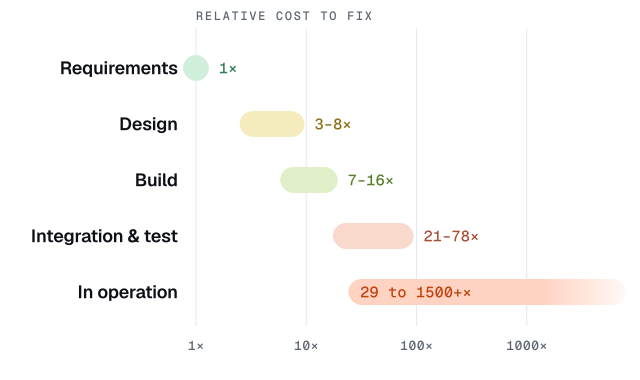
Relative cost of fixing one requirements error by the phase in which it is found: requirements 1 times, design 3 to 8 times, build 7 to 16 times, integration and test 21 to 78 times, in operation 29 to more than 1500 times.
Relative cost of fixing one requirements error, by the phase in which it is found (logarithmic scale). Source: J. M. Stecklein, J. Dabney et al., Error Cost Escalation Through the Project Life Cycle, NASA Johnson Space Center, 14th Annual INCOSE International Symposium, Toulouse, June 2004. The study draws on aerospace hardware and software projects; the exact factors differ for other products, but the trend is the point.
  • Problems found early, while they are cheap Every level is reviewed before the next one starts.
  • Acceptance agreed up front The acceptance test plan is written together with your requirements. It is the same list you approve before any invoice.
  • Every requirement traced A traceability matrix links each requirement to the design that meets it and the test that proves it.
  • Documents you own Requirements, architecture and test reports are yours to keep, for your own team, your manufacturer or your test lab.

MODERN TOOLS

Modern tools, faster routine work.
With the same engineering rigour.

Engineering tools have changed more in the last few years than in the twenty before. I work with the latest generation for analysis, simulation, firmware development and documentation. Routine work goes noticeably faster, and more of the time goes where it counts: design decisions, reviews and tests.

Less routine.

MORE TIME FOR ENGINEERING

Where the hours go on the same scope

Routine work
less
Reviews & tests
more
An illustration of the shift, not a measurement. Routine work means drafting, code scaffolding, formatting and cross-checking documents.
  • Faster delivery Routine tasks take less time, so your project reaches each milestone sooner.
  • Higher quality Time saved on routine work goes into reviews, test coverage and traceability. Documents stay complete, consistent and in step with the design.
  • Lower cost Fewer routine hours are reflected in the fixed price of your proposal. You pay for engineering, not for routine.
  • An engineer signs off Tools speed up the work; they do not make the decisions. Every schematic, every line of firmware and every document is reviewed and approved by me.

PCB fabrication, component lead times and test-lab schedules do not get faster with better tools, so they are planned in the proposal as before. Tools that process data externally are used on your project only with your authorisation (see confidentiality).

PROFESSIONAL BACKGROUND

Thirty years of R&D where silicon meets code.

I am Henrik Andersen, an electronic engineer with thirty years in R&D, developing hardware and software for consumer and industrial products. I lead a product from the first idea to start of production, and I know how to set up that production with EMS partners in Europe and China.

Experience

30 years

of R&D, developing hardware and software from the first idea to series production.

  • Full R&D
  • Hardware
  • Software
Education & method

Master's degree

in electrical engineering, applied through a V-model process: every requirement traced to its test.

  • V-model
  • Traceability
  • Design reviews
Production set-up

Europe & China

setting up production with EMS partners on both continents, including five years in China.

  • DFM reports
  • Test jigs
  • Production transfer
Platforms

3 MCU families

from 8-bit controllers under 10 euro cents in volume production to 32-bit connected products.

  • Arm Cortex-M
  • RISC-V
  • MCS-51 (8051)

Background

I have run complete developments from the first specification to series production, including the project management, and set up production with EMS partners in Europe and Asia, including five years in China. As an independent engineer I take on the full R&D of your product, or the part your team needs, and finish it.

Expertise

  • Full R&D and project management from idea to start of production
  • Requirements, specification and system architecture
  • Circuit design, schematic, PCB layout and design reviews
  • Embedded firmware in C for Arm Cortex-M, RISC-V and MCS-51 (8051)
  • Integration, verification, validation, acceptance tests and EMC pre-compliance
  • Design for manufacturing with full DFM reports, test jigs and production transfer
  • Production set-up with EMS partners in Europe and China

Working with

I work closely with test laboratories and with PCB and electronics manufacturing (EMS) providers in Europe and Asia, so a design moves into testing and production without hand-over gaps.

Test laboratories

SGS Belgium (CEBEC) · BGEMC · TÜV Rheinland · TÜV SÜD · cetecom advanced

PCB and EMS manufacturing

Eurocircuits · AISLER · PCBWay · Zhen Ding Technology · Foxconn

Company names are used for identification only and do not imply endorsement.

WHY WORK WITH SILICON MEETS CODE

Nothing to lose by asking.
No payment until you approve the delivery.

Choosing an engineer for your product is a big step. So the risk sits with me, not with you.

Step 1

We talk first

Tell me about your product and where it is today. This first conversation costs nothing and commits you to nothing. Nothing is ever billed without a written proposal you have accepted.

Step 2

A clear proposal

In writing: what I deliver, what it costs and how we both check that it is done. You know the full price before any work starts, and it only changes if you ask for more.

Step 3

You approve, then you pay

You check each delivery against the agreed criteria. Only when you have approved it do I send the invoice.

How we agree the work.

01

Acceptance criteria

Written into the proposal: what is delivered and how we both check that it is done.

02

Reviews

You review each delivery against those criteria, within a review period we agree in the proposal.

03

Change management

Changes are requested in writing. I quote the effect on price and time first; nothing changes until you accept it.

04

Milestone approval

Larger projects are split into milestones. Each is approved and invoiced on its own, and you can stop after any of them.

05

Intellectual property

Once paid, the designs, firmware source code and documents made for your project are yours. Third-party and open-source parts stay under their own licences.

Costs

External costs such as PCB fabrication, components or test-lab fees are agreed in the proposal.

Confidential by default.

NDA

Your files and ideas are confidential. An NDA can be signed before you share any details.

Suppliers

Project data is shared only with suppliers you have agreed to, such as a PCB manufacturer or a test lab.

AI tools

Some modern engineering tools, including AI assistants, process data on external servers. I use them on your project data only with your written authorisation, and only services that do not use your data to train their models. If you prefer, your project is handled without them.

CONTACT

Tell me about your product.
I read every message myself.

A new product to develop from scratch, a design that needs a second look, or a prototype that does not work yet: a few lines are enough to start.

  • A personal reply within one working day
  • No cost and no commitment up front: you only pay for work you approve
  • Your idea stays confidential, NDA on request (how I keep your project confidential)

Write to me

info@siliconmeetscode.com
Write an email

Helpful to mention: what the product does, where it is today, and your timeline. The email opens with these questions ready to fill in.

Working from Belgium and Germany with clients across Europe and Asia